Example: Film Grain Structure
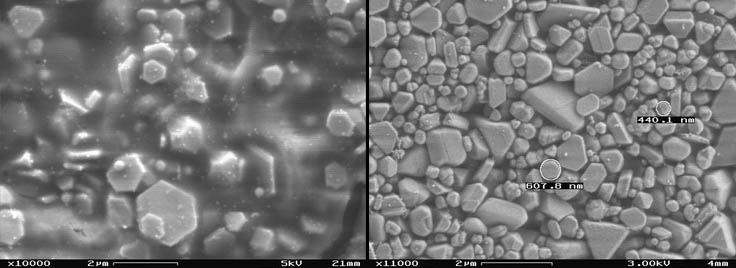
Microscopic view of silver halide particles embedded in gelatin and spread across a polyester base. Shows the difference in particle size/density between Low ISO and High ISO film.
The creation of a photograph is fundamentally a mechanical and chemical (or digital) process of capturing light. A perfectly exposed picture is a careful balance of functions that dictate how much light hits the sensor or film, and how sensitive that medium is to the light.
Exposure in a camera is controlled by balancing depth of field,11. The distance between the nearest and furthest elements in a scene that appear to be “acceptably sharp” in an image. Controlled primarily by the lens aperture (f-stop). motion blur, and light sensitivity. Generally, a photographer hones in on the aperture they want to achieve a specific depth of field before choosing their shutter speed or altering sensitivity.
The baseline foundation of any exposure calculation is determining how receptive your recording medium is to light.
ISO: A numerical rating representing a camera’s sensitivity to light, pertaining to either the film stock or a digital sensor.
Microscopic view of silver halide particles embedded in gelatin and spread across a polyester base. Shows the difference in particle size/density between Low ISO and High ISO film.
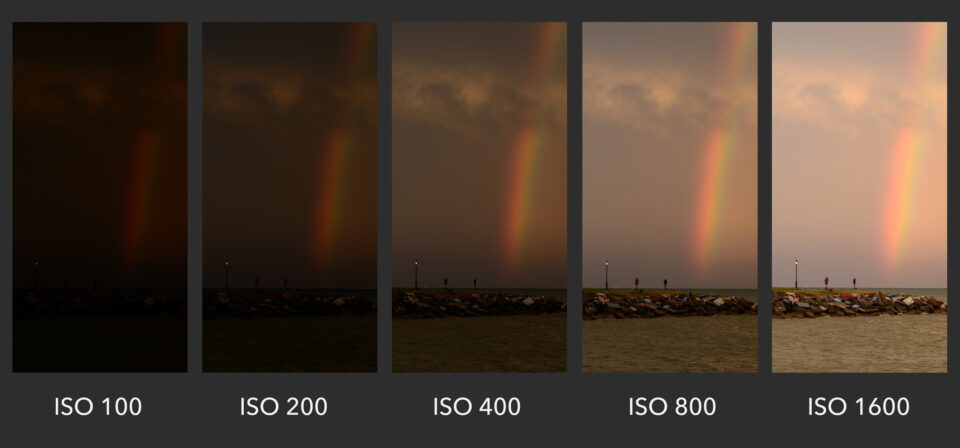
When the balance of light, time, and sensitivity fails, the image breaks down in one of two directions.
Overexposure: A state where too much light is allowed in during the exposure, resulting in an overly bright, washed-out photograph.
Underexposure: A state where too little light is allowed in during the exposure, resulting in an overly dark photograph.
Long before chemical photography was invented to permanently fix an image, artists used optical principles to project images of the real world for observation and tracing.
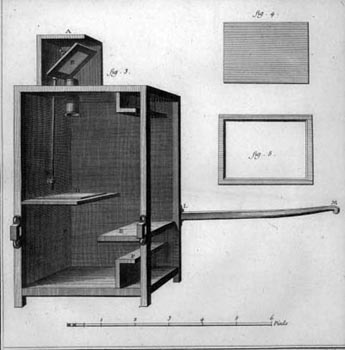
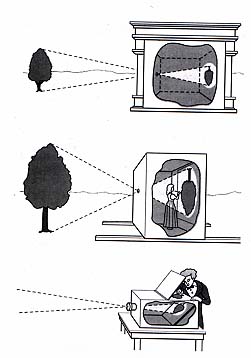
Camera Obscura: An optical device (literally translating to “dark room”) that projects an inverted image of its surroundings onto a screen or wall.33. The fundamental optical principle where light rays from an illuminated scene pass through a small hole in a darkened enclosure, crossing paths and projecting an upside-down, reversed image on the opposite wall.
Early camera obscuras were literal rooms that an artist would stand inside. Later, portable wooden boxes were developed with a mirror inside at a 45-degree angle, projecting the image up onto a piece of frosted glass so the artist could lay paper over it and trace.
The distance between the nearest and furthest elements in a scene that appear to be “acceptably sharp” in an image. Controlled primarily by the lens aperture (f-stop).↩︎
On analog film, higher sensitivity requires physically larger silver halide crystals in the emulsion, which become visible as a gritty texture (“grain”) when developed and printed.↩︎
The fundamental optical principle where light rays from an illuminated scene pass through a small hole in a darkened enclosure, crossing paths and projecting an upside-down, reversed image on the opposite wall.↩︎